Format: Three case presentations with discussion (approximately 11 minutes each), plus a paper presentation by Fadia Youssef Sharobeem Abdallah (2:30–2:45 PM; 10-minute presentation and 5-minute Q&A).
Speakers: Gianmarco Cristofari, Taru Jain, Luke Smith, Fadia Youssef Sharobeem Abdallah
We treat solidarity as a practice. Every case asks: Who shares time or resources? Who makes the decisions? Who carries the costs? What obligations do participants have to one another?
Gianmarco Cristofari analyzes and theorizes Pix, Brazil's public payment infrastructure, and its radical effects on the lives of Brazilian people. As public payment infrastructure, Pix builds on a variety of community practices while strengthening Brazil's digital sovereignty.
Taru Jain starts from the point that not all cooperatives start as cooperatives. She charts a journey still in progress: turning a platform built to aid landscape stewards into a cooperative they run entirely themselves. The case is CoRE Stack, a community-centered digital public good for climate resilience in rural India, and its integration into landscape stewardship workflows. In use by 500 landscape stewards across more than 20 civil society organizations, CoRE Stack makes visible new forms of solidarity among the public, stewards, and civil society working to manage natural resources fairly and resiliently.
Luke Smith explains that farm-level, holistic outcome data is fast becoming a necessity for agricultural commodity buyers, who must comply with strict new legislation, meet the expectations of conscious consumers, and manage supply chain risk. Using the example of a regenerative rubber farming network in Thailand, he shows how Origins Co-op meets these demands while improving community wellbeing and the health of production landscapes. He argues that integrating agricultural value chains from the bottom up expands the ownership, control, and governance power of smallholder networks, which is critical for equitable, regenerative, and resilient supply systems.
2:30 PM to 2:45 PM: Paper Presentation
Does Governance Shape the Impact of Artificial Intelligence on Environmental Quality? Evidence from Developing Countries.
Fadia Youssef Sharobeem Abdallah
10-minute presentation followed by 5 minutes of questions.
Fadia Youssef Sharobeem Abdallah examines whether governance shapes the relationship between artificial intelligence and environmental quality. Her study uses panel data from 131 developing countries covering 2000–2024, subject to data availability, with AI publications as a proxy for AI development, total CO₂ emissions as the environmental measure, and the Worldwide Governance Indicators. Combining Pooled Ordinary Least Squares with two-step System GMM estimation, the study finds an inverted U-shaped relationship: AI development is initially associated with higher emissions, but beyond a certain level, further development is associated with lower emissions. Stronger governance is associated with a more environmentally beneficial relationship between AI and emissions. The paper asks how institutional conditions shape AI’s environmental consequences.
Reporter 1: Gianmarco Cristofari
Reporter 2:
Speakers
-
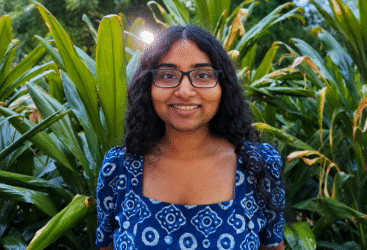
Taru Jain Senior Design Researcher
-

Gianmarco Cristofari Assistant Professor at Universidad Iberoamericana
-

Luke Smith regenerative designer, educator, and cooperative entrepreneur
-

Fadia Youssef Sharobeem Abdallah PhD candidate in Economics at Cairo University’s Faculty of Economics and Political Science