O.U.R. COOP
Image by KICKOIDLOOP, as part of the Shared Vision visual identity
A Community Currency for the Arts
by Alessandro Y. Longo
In late May 2026, over fifty artists, cultural workers, researchers, and cooperative practitioners gathered in Nikšić, Montenegro, for five days of working sessions. On the last day, in the mining town, they signed the founding documents of O.U.R. COOP, an international social cooperative of visual artists headquartered in Belgrade. The bureaucratic process was quick, and in fifteen minutes the documents were ready. Getting there was not.
O.U.R. COOP is the outcome of Shared Visions, a Creative Europe–funded project that set out to build a sustainable and inclusive cooperative for visual artists in Europe. The project brings together institutional partners across the continent, including Fund B92 and SULUV in Serbia, Avans University of Applied Sciences in the Netherlands, the Milanese association Landscape Choreography, the designer cooperative KicKVoidLoop based in Porto, and the Montenegrin Institute of Contemporary Art, alongside technical collaborators like Curve Labs (of which the author is a member) and Bread Cooperative.
The alliance behind Shared Visions is born of a productive contradiction: between being an artist in Western Europe and being one in the southeastern part of the continent, commonly called the Balkans. Within Shared Visions, we have analyzed and discussed both our common ground and our differences. We all experience the precarity of the financialized art market, its structural instability, and the growing withdrawal of state support for the arts we depend on. But it is in the Balkans that these conditions are harsher and less bearable, in an economically fragmented landscape that Western European cultural policy rarely addresses directly. Neither the state nor the market has provided support or dynamism for the art sector of the region, which survives through the remarkable resilience and inventiveness of its practitioners, a structural vibrancy that refuses to be stopped.
The reasons behind these differences lie in the history of the continent, and it is by digging through the rubble of that history that the inspiration for Shared Visions was born. Yugoslavia, the trans-Balkan socialist federation founded by Marshal Tito and existing between 1945 and 1992, always oriented its economy beyond the rusty dichotomy of State and Market through its system of workers’ self-management and social ownership, generating a tradition of collective economic organization with few equivalents elsewhere in Europe. This tradition of intermediary bodies extended to the arts as well. At the federal level, artists were organized within SULUJ (Savez udruženja likovnih umetnika Jugoslavije), the Union of Associations of Visual Artists of Yugoslavia, founded in 1947, which gathered the various national associations such as the Croatian HDLU or the Serbian ULUS. And it is from within a group of members of ULUS, the association based in Belgrade, that the idea of creating a cooperative for artists in the region took shape. Tired of the battles of representative democracy, of petitioning deaf and blind governments like the feckless Vučić administration, a group of members decided to rediscover the cooperative form, as several other artists’ organizations have done in recent years across Europe.
The cooperative form is particularly well suited to this work because it combines democratic governance and shared ownership with the capacity to act as an economic enterprise, although its ability to operate across borders depends on national law. For artists in Serbia or Montenegro, where the institutional landscape provides little and the market provides less, a cooperative can negotiate collectively, pool purchasing power, access international funding, and distribute resources according to rules its members set for themselves. It is an attempt to build the economic infrastructure that the state has failed to provide.
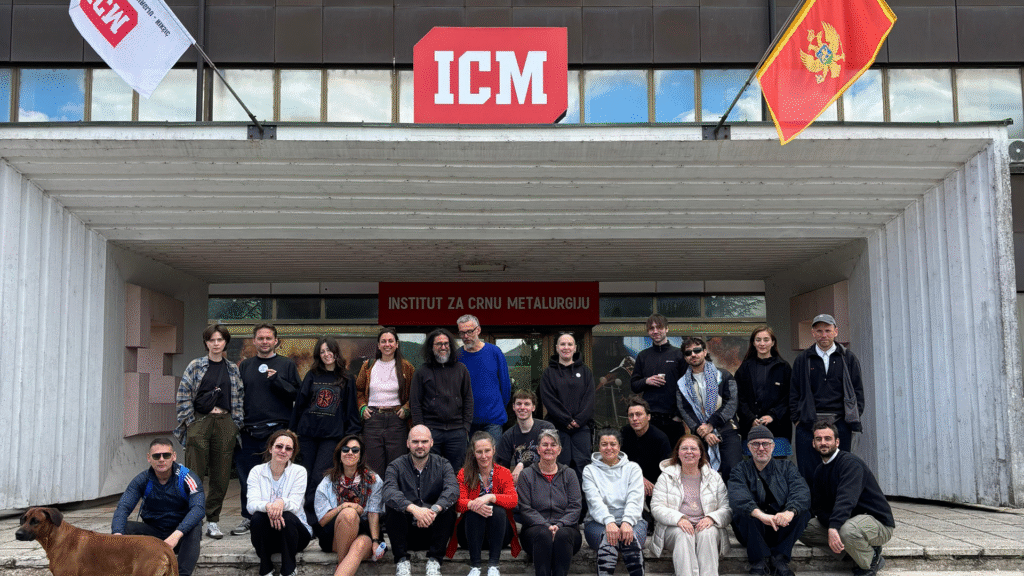
Group pic from the Niksic founding assembly
Shared Visions has also pursued, from the beginning, a second conviction: that digital tools designed with and for the cooperative can strengthen this infrastructure. What kind of technology serves a transnational body of artists who need transparent accounting, democratic decision-making, and a shared economic layer that works across different currencies and jurisdictions? That question has shaped the project’s technological research over the past two years.
Shared Visions, Shared Currency
The technological proposition of Shared Visions emerges from the encounter between the artistic and cooperative ambitions of the consortium and two organizations operating at the frontier of tech cooperativism and blockchain experimentalism: Curve Labs and Breadchain. Through this collaboration, the nascent cooperative is developing a platform to structure its economic interactions, centered on the coop’s community currency. Technically, the OUR Coin (the name is still temporary) is a stablecoin pegged to the euro, built on Gnosis Chain with smart contracts designed by Breadchain. The token is non-speculative and transferable among members, and it can be redeemed for euros through the cooperative’s coordinators, who handle fiat exchange, withdrawals, and fund execution.
Shared Visions approaches blockchain with what we have called a “critical curiosity,” deliberately dis-aligned from the hyper-financial and speculative culture that has dominated mainstream crypto. The interest is practical: blockchain can provide what Erik Bordeleau, one of the project’s researchers, has described as an infrastructure for “accounting otherwise,” allowing a transnational group to track contributions, distribute resources, and make collective ownership legible across the fragmented legal and financial systems of contemporary Europe.
The cooperative needed a shared economic layer that could work across currencies and jurisdictions without depending on any single national banking system. The logic of the token system is straightforward. When a patron acquires artwork through the cooperative, the transaction is validated by the cooperative itself and the artist receives tokens. These tokens circulate within the cooperative’s internal economy: members can use them for collective purchasing of materials and supplies, for shared services, or hold them as a transparent record of what they have contributed to the common pool. The system also accumulates yield through decentralized finance protocols, and the generated interest helps fund cooperative activities. How that yield is governed is being developed gradually, in dialogue with members. Following the reading group’s insight that we should not place “structure before culture,” the governance protocols are emerging from the cooperative’s conversations rather than being imposed on them.
The project has also been experimenting with participatory decision-making tools. During a Radionica workshop I led at the SULUV gallery in Novi Sad last autumn, the group tested quadratic voting as a method for democratic art commissioning. In quadratic voting, participants receive a budget of vote credits they can distribute across competing proposals, but each additional vote on the same proposal costs quadratically more. The mechanism captures how strongly people feel about a preference, and prevents any single voter from dominating the outcome. Participants used a mobile interface to allocate votes in real time. It was a small experiment with a large question behind it: can a group of artists with different stakes use a participatory tool to reach a fair collective decision about resource distribution? The frictions observed, from the learning curve of the interface to the social dynamics of visible versus anonymous voting, fed directly into the design of the cooperative’s governance framework. These are what Josh Davila (fka The Blockchain Socialist) calls small “units of use and capacity”: modest digital tools that, taken together, allow a community to develop its own social, economic, and cultural frameworks from the ground up.
Shaping a Collective Body
The most underreported dimension of Shared Visions is the cultural labor that preceded and accompanied all of these technical developments. A cooperative cannot simply be declared into existence. It requires a shared political culture: common references, a capacity for productive disagreement, and enough mutual trust to hand over resources to collective stewardship. Building that culture has been a fundamental part of the patient, unglamorous work of the past two years.
The project organized a series of reading groups where members collectively studied texts relevant to cooperative organization and digital commons. One cycle focused on Artists, Activists, and Worldbuilders on Decentralised Autonomous Organisations, a volume published by the Institute of Network Cultures that collects interviews with practitioners working at the intersection of art, blockchain, and collective organization. A second reading group, launched this year, takes on a heavier text: What Is To Be Done?, approached not as scripture but as a spur for debating what organized political action means in the present.
In the reading groups, members began to develop a shared vocabulary for the decisions they would later face: how to distribute resources, how to handle disagreement. This is not something a governance protocol can produce purely on its own. It requires conversation, patience, and a willingness to sit with unresolved questions.
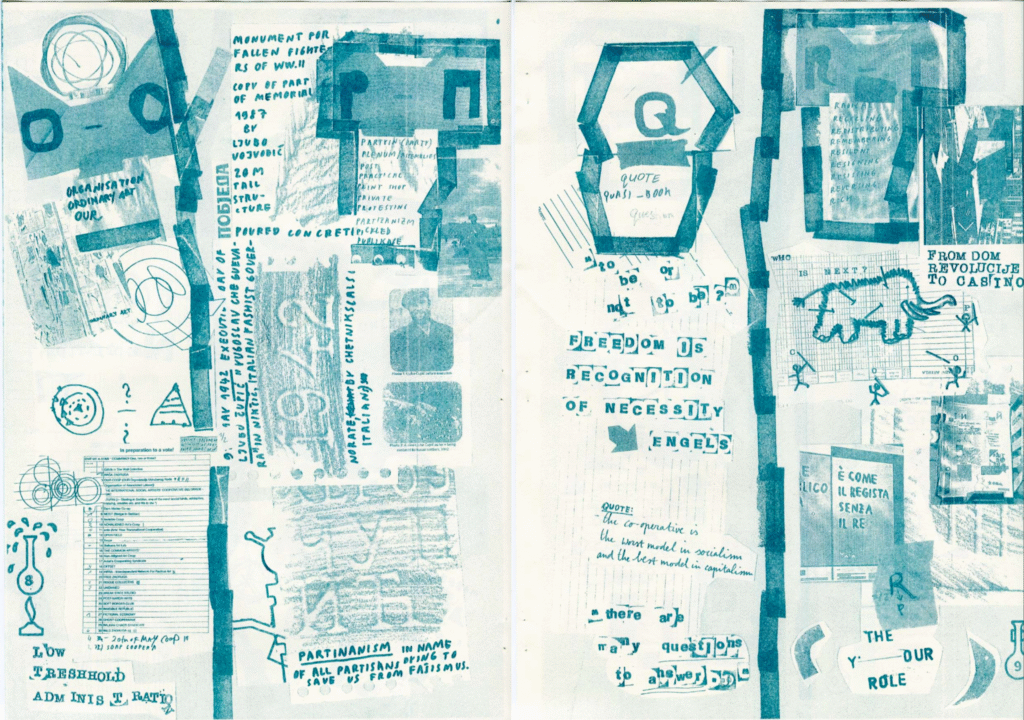
Excerpt from Coop Or Die Issue 1.
Part of this inventory of imaginative tools includes a series of Live Action Role Play sessions organized in Belgrade and Berlin as a collective exercise in economic imagination. The idea, proposed by Curve Labs, draws on the Autonomia tradition’s insight that practicing alternative forms of organization is itself a political act: by “acting as if” a different economy already exists, participants begin to develop the skills, reflexes, and trust required to actually build one. In the LARP, participants role-played scenarios in which a cooperative had to make difficult allocation decisions (what happens when demand exceeds resources, who arbitrates between competing priorities), testing the emotional and political weight of mechanisms that might otherwise look abstract on a whiteboard.
More recently, the cooperative launched PROBLEMZINE, its first collaborative publication, which inverts the logic of the artist portfolio: instead of presenting achievements, members shared problems (financial, institutional, personal), treating them not as failures to hide but as shared conditions to analyze and organize around. The premise is that a cooperative starts from an honest accounting of what its members actually face, not from aspirational mission statements, and by rejecting the neoliberal ideology of the ever-grinding individual artist in favor of more collective aspirations.
All of this work rests on a conviction that infrastructure is built in common understanding, in shared imaginaries and dreams, not only in code.
Barely three months old, O.U.R. COOP is still in its incubation phase. Its economic activities, from editorial initiatives to collective exhibitions and shared services, are still taking shape, guided by member input and by the ongoing exploration toward a stable business model within the two years left of the European project. The cooperative is a bet that the crisis of artistic labor in Europe cannot be solved individually, and that cross-border solidarity is worth the organizational complexity it demands. It is also a bet that technology and culture can develop together rather than in opposition, that Western and Eastern Europe can find common ground in spite of their differences, and that the arts can still be a site for tackling societal troubles instead of just justifying or intensifying them. It is a hazardous bet, but it is OUR bet.
More about the author