Nov 5
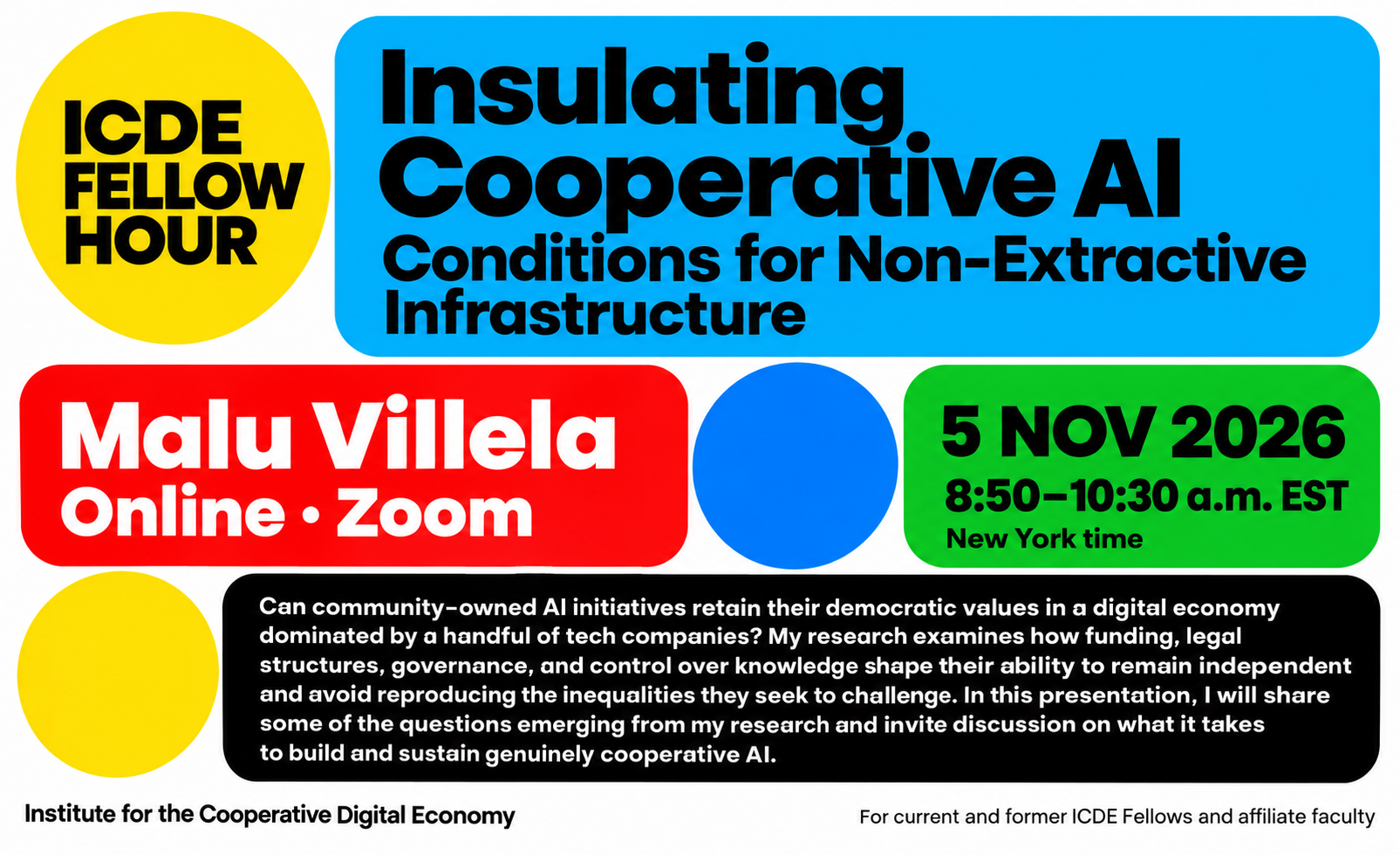
Can community-owned AI initiatives retain their democratic values in a digital economy dominated by a handful of tech companies? My research examines how funding, legal structures, governance, and control over knowledge shape their ability to remain independent and avoid reproducing the inequalities they seek to challenge. In this presentation, I will share some of the questions emerging from my research and invite discussion on what it takes to build and sustain genuinely cooperative AI.
Reading
Beyond Ethical AI
https://platform.coop/blog/beyond-ethical-ai/
“My article argues that cooperative and community-owned AI initiatives can remain non-extractive and democratic only when structural changes in finance, governance, and infrastructure protect them from corporate capture. It provides a foundation for my research by shifting the focus from ethical AI principles to the structural and political-economic conditions necessary for democratic AI.”
Supplementary Readings
The Great AI Acceleration: Problems of Scale in Artificial Intelligence and the Anthropocene: https://www.journals.uchicago.edu/doi/abs/10.1086/741655
“This paper examines the material demands and planetary constraints associated with AI’s expansion. It introduces an ecological dimension to the discussion, raising questions about whether cooperative AI can avoid reproducing the resource-intensive assumptions of the dominant AI industry, and whether non-extractive infrastructure requires alternative approaches to scale.”
Community Business and Technology (Research Report):
https://www.careful.industries/blog/2025-5-community-business-and-technology
“This report, based on research I conducted with colleagues, examines how UK community businesses navigate resource constraints and corporate dependencies while developing community-led governance arrangements. It offers a grounded perspective on the practical challenges of sustaining community ownership within wider market structures.”
Building a Solidarity Ecosystem for AI:
https://ssir.org/articles/entry/artificial-intelligence-solidarity-ecosystem
“This article explores a potential “solidarity stack” involving federated cooperatives, data trusts, and public partnerships. It provides a practical starting point for considering how collective institutions and shared resources might reduce community-led AI initiatives’ dependence on dominant technology providers.”
Why ‘open’ AI systems are actually closed, and why this matters:
https://www.nature.com/articles/s41586-024-08141-1.pdf
“This paper examines the limits of openness in AI, drawing attention to the technical, computational, and infrastructural dependencies that can persist even when models or components are presented as open. It raises questions about whether openness necessarily redistributes power, or whether it can coexist with concentrated control over the resources needed to develop and deploy AI.”