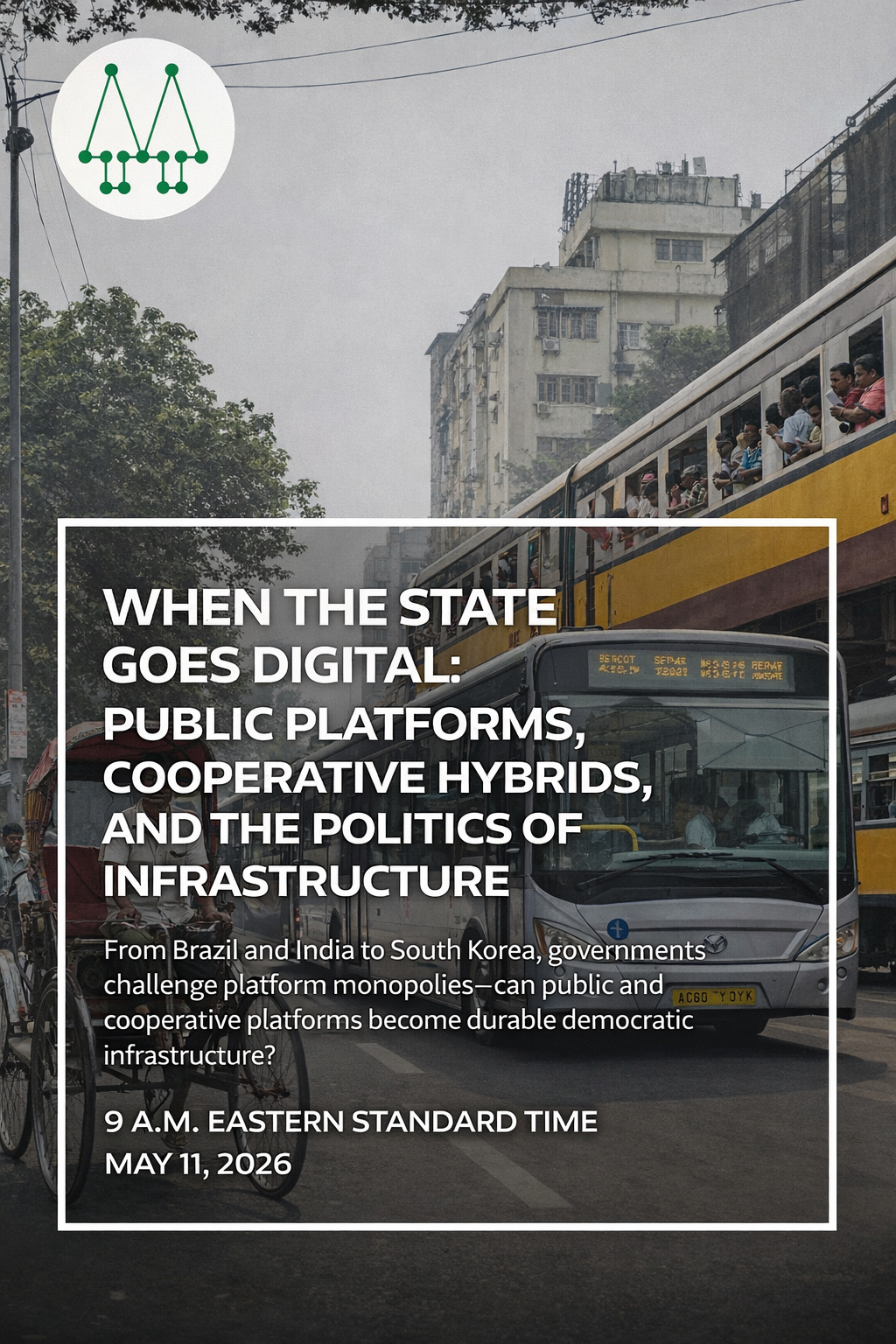
When the State Goes Digital: Public Platforms, Cooperative Hybrids, and the Politics of Infrastructure
Date: May 11
Time: 9:00 AM ET
Speakers:
Jeongone (Joh) Seo (Rutgers University)
Kenzo Soares Seto (Yale University)
Trebor Scholz (The New School / Harvard University)
Ganesh Gopal (Gandhigram Rural Institute)
Registration Required
Across Brazil, South Korea, and Kerala (India), governments have stepped into digital markets to confront platform monopolies, reduce labor precarity, and prevent the loss of local economic value. These interventions have taken many forms: state-owned apps, public–cooperative hybrids, and efforts to formalize digital solidarity economies. While often launched with strong public-facing missions such as lower fees and better working conditions, many of these initiatives have struggled to achieve viability in markets shaped by network effects, rapid iteration cycles, and dependence on private cloud and payment systems.
This event examines a central policy question: under what institutional conditions can public or cooperative digital platforms achieve both economic durability and democratic governance?
Drawing on comparative research and case studies, the discussion moves beyond the idea of launching isolated public apps. Instead, it focuses on digital platforms as infrastructure—shared software stacks, cooperative cloud services, procurement systems, interoperable standards, and governance frameworks that align public value with operational viability.
Particular attention will be paid to governance structures that prevent bureaucratic capture, capital designs that support early-stage losses without undermining autonomy, and regulatory strategies that create fair market conditions. Lessons from prior experiments highlight that ownership labels alone are insufficient; durability depends on integration, sovereignty over core infrastructure, and stable institutional alignment. At stake is not simply the success of individual platforms, but the broader question of how digital markets can be organized in ways that retain value locally, protect workers, and strengthen public capacity.