Ten Years After Uberworked and Underpaid: What Changed, What Held, What’s Next
Date:
Registration Required
Time:
9 am ET
In 2016, when the first essay on platform cooperativism appeared, the platform economy was still celebrated as innovation and “sharing,” not recognized as a new regime of labor governance. Uberworked and Underpaid intervened in that moment, arguing that platforms were not neutral technologies but infrastructures that organize, direct, and discipline work. It asked a simple but unsettling question: who bears the risks of this new economy? Crucially, it refused to end with critique. Nearly half the book was devoted to advancing platform cooperatives as a practical, worker-owned alternative.
A decade later, the dynamics identified then have not faded; they have deepened. Algorithmic management is normalized. “Deactivation” has become an everyday form of automated dismissal. AI systems now mediate pricing, scheduling, evaluation, and discipline. Platform monopolies have consolidated their power and embedded themselves within public infrastructures. And yet the idea that workers could build and govern their own platforms did not disappear. Platform cooperatives did not overthrow Big Tech, but they became tangible—informing policy debates, shaping legal reforms, and engaging more than a million workers across dozens of countries.
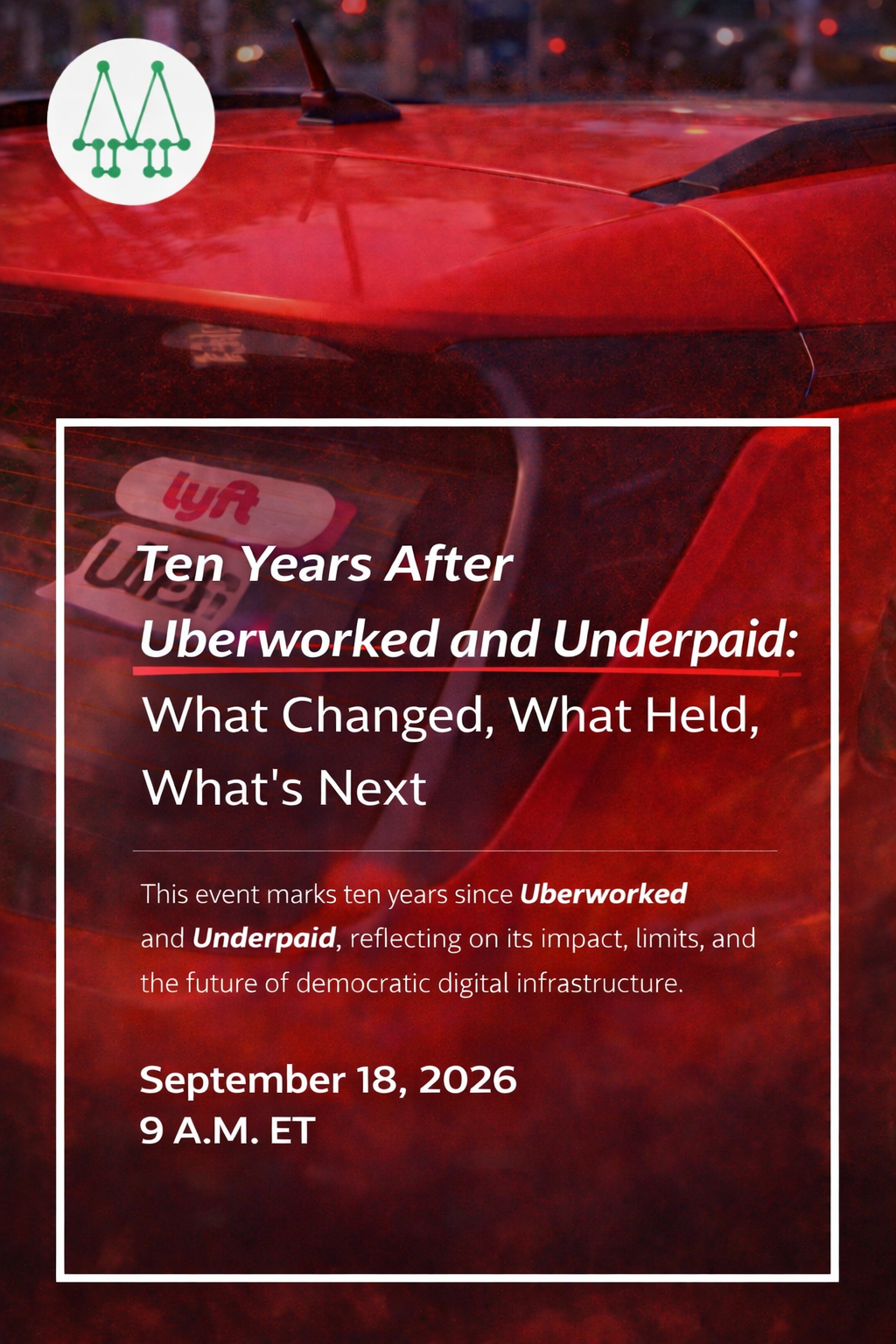
This event marks ten years since both Trebor Scholz’s Rosa Luxemburg Foundation essay, which first articulated the concept of platform cooperativism, and the publication of Uberworked and Underpaid in 2016. Looking back at that early turning point, we ask: What endured? What fell short? What emerged that we could not yet see? If the first decade tested democratic intervention at the level of the app, the next confronts the deeper question of infrastructure. In an AI-driven economy, the challenge is no longer only whether platforms can be owned democratically, but whether cooperative principles can extend across the digital stack itself. The work continues.