Open Call for Applications (2026–2027) ICDE Fellowship Program
At a Glance
- Submission Deadline: January 20, 2026 (11:59 pm ET)
- Who Should Apply: Ph.D. candidates, post-docs, junior and early-career faculty, and applicants with equivalent research experience
- Format: Non-residential; remote participation throughout the year
- Key Requirement: In-person participation and presentation at the Platform Cooperativism Consortium Conference (November 12–15, 2026, Chulalongkorn University, Bangkok, Thailand)
- Research Orientation: Empirical, comparative, and interdisciplinary;
- Outputs: One substantial research output plus at least one public-facing contribution
- Support: Mentorship from ICDE faculty, senior researchers, and fellows; access to global networks; conference travel support
- Deadline for Submission: January 20, 2026 (11:59 pm ET)
Overview
The Institute for the Cooperative Digital Economy (ICDE) at The New School invites applications for its 2026–2027 Fellowship Program, a global research program for scholars examining how cooperatives, unions, and solidarity-economy organizations are engaging with digital systems, including artificial intelligence and data-intensive infrastructures.
ICDE supports empirically grounded, comparative, and theoretically robust research on how digital infrastructures, including platforms, AI systems, data regimes, and algorithmic management, are evolving across diverse institutional and social contexts. The fellowship encourages open-ended, interdisciplinary inquiry that brings together perspectives from the social sciences, law, media studies, science and technology studies, organizational research, and related fields. ICDE welcomes work that develops and tests new concepts, frameworks, and comparative approaches to questions of governance, institutional design, and inequality in digital economies, while remaining attentive to real-world practices and constraints.
The fellowship emphasizes case-based and empirically engaged research, inviting fellows to explore concrete institutional settings through comparative analysis, conceptual experimentation, and inquiry into alternative organizational arrangements that may inform policy discussions and organizational practice.
A defining feature of the ICDE Fellowship is its focus on public-facing research outputs that are accessible and relevant to a range of audiences, including practitioners, organizations, and academic communities. Fellows are encouraged to develop work that engages with existing organizations, clarifies institutional or governance questions, and contributes to shared learning across cooperative and solidarity-economy ecosystems.
The program builds on ICDE’s position at the intersection of public scholarship, cooperative practice, and policy-relevant research, while fostering a collaborative cohort environment that supports mutual learning, exchange across fields, and contributions to a shared yet open-ended intellectual agenda.
Institutional Context
ICDE is based at The New School in New York City, a university founded in 1921 with a long-standing commitment to social justice, interdisciplinary inquiry, and experimental scholarship. ICDE drives the research agenda of the Platform Cooperativism Consortium (PCC), which convenes a global network of scholars, cooperators, policymakers, and organizers. Read the most recent PCC report for additional context on the Consortium’s scope and activities.
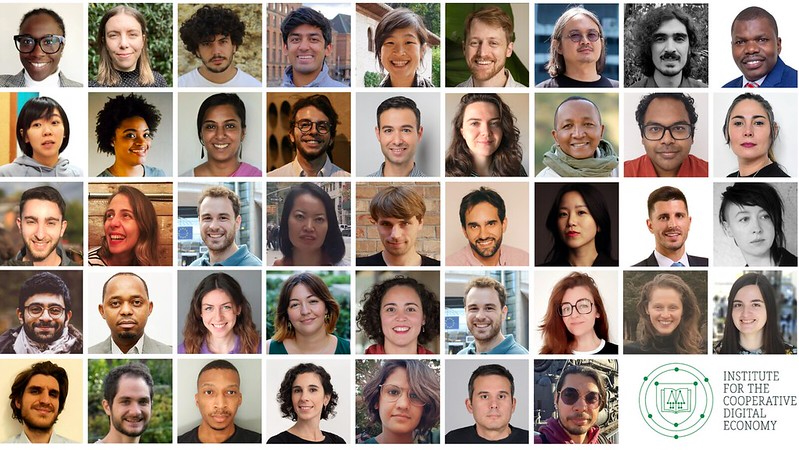
Since 2019, ICDE has supported 58 research fellows whose work has shaped the academic field of Solidarity Tech, informed public policy debates, and strengthened cooperative ecosystems across more than 60 countries. PCC and ICDE convene an annual international conference and maintain widely used research resources, directories, and publications that connect scholarship to practice.
ICDE works with a large number of affiliated faculty across a wide range of institutions, including public universities, cooperative universities, independent research institutes, policy organizations, and movement-based institutions in Europe, Africa, Asia, Latin America, and North America, who contribute to the Institute’s research direction, mentoring, public programming, and collaborative projects.
Who Can Apply?
ICDE welcomes applications from:
– Ph.D. candidates and post-docs
– Junior and early-career faculty
Applicants with equivalent research experience and a demonstrated record of scholarly or applied research may also be considered. We also welcome collaborative or paired applications in which two applicants propose aligned or joint research agendas.
Applicants should demonstrate:
— Engagement with, or clear plans to engage, specific cooperatives, unions, federations, or collective initiatives as part of their research process
— A clear research question grounded in real-world cases
— Capacity to contribute to a collaborative cohort and shared outputs
— Familiarity with cooperative, labor, or solidarity-economy contexts
Fellowship Modality
This is a non-residential fellowship. Fellows participate remotely in ICDE programming throughout the year.
All fellows are required to attend and present at the Platform Cooperativism Consortium Conference, taking place November 12–15, 2026, at Chulalongkorn University in Bangkok, Thailand. Applicants should apply only if they are confident they can attend the conference in person.
The Bangkok conference serves as the central intellectual and community anchor of the fellowship, convening scholars, cooperative leaders, workers, technologists, and policymakers around the theme of Solidarity AI.
Hosted in Southeast Asia, the conference foregrounds Global South perspectives and cross-regional exchange, bringing research into dialogue with lived experience, ongoing cooperative experiments, and debates on platform labor, data-intensive digitalization, and AI governance. Fellows are expected to present their work in accessible formats and to participate actively in workshops, panels, and informal discussions that support collective learning and future collaboration.
Research Focus Areas (2026–2027)
Applicants may propose research aligned with, but not limited to, the following areas. ICDE particularly welcomes work that reflects one or more of these orientations, which have been central to past and prospective fellows’ work.
Core Research Orientations
— Law, regulation, and public policy related to cooperatives, platforms, AI, data governance, and labor
— Political economy and institutional analysis of digital capitalism and alternative economic arrangements
— Empirical and ethnographic research on platform labor, cooperative practice, and informal economies
— Action research and design justice using participatory and co-design methods
— Data governance, surveillance, and digital rights, including interoperability and public-interest technology
— Global South–grounded and decolonial research, including South–South exchange and regionally specific cooperative models
— Movement building, federation, and scaling without centralization across sectors and places
— Technical or computational research embedded in questions of collective governance
Priority Research Themes
Worker-Led AI and Cooperative AI Systems
Research on AI systems governed, designed, or deployed by workers, cooperatives, or unions, including AI as economic coordination infrastructure, algorithmic management within cooperatives, and worker-facing AI tools that support autonomy, dignity, and democratic control.
AI Systems Within Cooperative Platform Economies
Research examining how AI systems are embedded within digital platforms and cooperative enterprises, focusing on algorithmic decision-making, data governance, and automation inside platform cooperatives and traditional cooperatives.
Inactive, Stalled, or Failed Platform Cooperatives
Comparative and diagnostic research on platform cooperatives that have paused operations, struggled to scale, or failed, including analysis of governance breakdowns, capital constraints, market pressures, and recovery or turnaround strategies.
State-Facilitated and Public-Interest Platform Cooperatives
Research on the role of the state in enabling cooperative digital economies through regulation, public procurement, and infrastructure, including state-facilitated platform cooperatives, digital public infrastructure initiatives such as India’s Bharat Taxi, and municipal–cooperative partnerships.
Measuring Impact and Viability
Empirical research assessing whether and how platform cooperatives and adjacent solidarity enterprises improve wages, working conditions, job security, governance participation, and long-term sustainability, including research informed by disability studies. Mixed-methods and comparative approaches are welcome.
Rethinking Digital Solidarity in the Global South
Research grounded in the Asia-Pacific region in particular, as well as Africa, Latin America, and other regions often marginalized in digital economy research, including South–South cooperation, migrant- and refugee-led initiatives, informal economies, and locally grounded cooperative models.
Imagining the Solidarity Stack
Research contributing to the conceptualization of a Solidarity Stack: federated, democratically governed digital infrastructure spanning data, platforms, compute, and AI systems, emphasizing interoperability, collective governance, and movement ownership across regions.
Research Expectations
ICDE places particular emphasis on community-facing research outputs with demonstrable relevance for real-world collectives. Fellows are expected to translate rigorous research into forms that can circulate beyond academia and be taken up by cooperatives, worker organizations, unions, federations, and other actually existing solidarity-economy formations. Preference is given to research that engages concrete organizational settings, ongoing struggles, or collective decision-making processes.
Fellows are expected to:
Produce a substantial research output (approximately 8,000–10,000 words) suitable for publication as a report, working paper, or academic article, written in a way that is accessible to non-academic readers whenever possible. Examples of recent work that illustrate the expected scope and style include Legalize Global Co-Ops by Santosh Kumar Padmanabhan, Principles for a Cooperative Technopolitics by Eve O’Connor, and Everything Old Is New Again: Evaluating the Legal and Governance Structures of Shared-Services Platform Cooperatives by Morshed Mannan.
Participate actively in cohort discussions and ICDE programming
Present their work at the PCC Conference in Bangkok (Nov 12-15, 2026), engaging directly with cooperators, workers, technologists, and policymakers
Contribute to at least one public-facing output (e.g. blog post, policy brief, workshop, teach-in, or resource for cooperatives), with an emphasis on practical relevance, movement usefulness, and tangible value for specific collectives or cooperative ecosystems
While individual research projects remain central, ICDE strongly values collaborative thinking, shared problem definition, and cross-fellow engagement, especially where this leads to shared resources, collective learning, or tools that can be used by communities beyond the fellowship cohort.
Benefits and Program Details
Fellows receive:
- Mentorship and feedback from ICDE faculty, senior researchers, and fellows
- Access to ICDE’s global network of scholars, cooperators, unions, and policymakers
- Opportunities to collaborate on research sprints, events, and publications
- Travel and accommodation support to attend the PCC Conference (conference-related costs only)
Fellows are responsible for securing their own visas.
Equity, Inclusion, and Global Access
ICDE is committed to fostering a diverse, inclusive, and equitable global research community. This year, we explicitly invite applications from scholars based in the Asia-Pacific region, reflecting the Institute’s growing engagement with cooperative ecosystems, digital labor, and AI governance across the region.
We welcome research grounded in political economy and labor analysis, including work that examines worker organization, collective bargaining, and conflicts over power, ownership, and value in digital economies. We strongly encourage applications from researchers of all backgrounds, particularly those historically underrepresented in academia, including but not limited to gender identity, caste, race, ethnicity, disability, nationality, religion, socioeconomic background, and class.
Application Requirements
Applicants must submit:
- A CV (maximum 4 pages)
- A 1–2 page research proposal, including:
- Research question and motivation
- Empirical focus or case study
- Methods and timeline
- Relevance to ICDE’s research focus areas
- One writing sample demonstrating prior research
- Contact information for two academic or professional references
Collaborative or paired applications should clearly describe the relationship between projects.
Information Session
An online information session will be held in early January 2026. Registration details will be shared on the ICDE website.
How to Apply
Submitted your application through this online form.
We look forward to working with a cohort of fellows committed to building cooperative, democratic, and solidaristic digital futures.
Timeline
Submission deadline: January 20, 2026 (11:59 pm ET)
Review period: Late January 2026
Interviews: Early February 2026
Notifications of acceptance: Mid-February 2026
Acceptance confirmation deadline: Late February 2026