Designing Economic Belonging for International Families in Aalborg
Aalborg, a city in northern Denmark, actively recruits international workers and students, yet often struggles to integrate their families. When highly qualified spouses remain unemployed, the image of a thriving life in a picturesque city begins to blur.
The job market is especially difficult for those with backgrounds in the social sciences, humanities, and arts. As a result, despite their high levels of education, many international residents face structural marginalization. They move through unpaid internships, precarious part-time work, and long periods of job searching, often turning to entrepreneurship or freelancing as strategies for survival.
“Before international families can contribute, they need to belong.”
As part of the Reworlding project, I am collaborating with Aalborg Municipality to explore whether platform cooperativism could be one possible response. Especially in a new country, starting a business can be daunting and resource-intensive; forming a cooperative may be one way to meet that challenge.
At the same time, in a capitalist context, the cooperative model is often simply not top of mind as a go-to option. On top of that, people moving to a new country often know very little about the cooperative landscape there. Although cooperative businesses, or “democratic businesses,” as they are called, are valued in Denmark, access to the knowledge, networks, and programs around them is concentrated in the capital region and largely available only in Danish.
When I started researching this, it became clear very early in the fieldwork that, for most participants, there was a real fog of uncertainty around the cooperative model. Questions came up again and again: “Who decides where the money goes?” “Will I lose control over my idea?” “Is revenue shared equally?”
This lack of familiarity triggered interconnected fears: fear of losing autonomy, fear of the unknown, and fear of entering a model they did not fully understand. If collective imagination was to flourish, we needed to create a safe space for collaboration.
That is where design can intervene: to build tools and build capacity.
Making Cooperativism Legible: Design Tools as Translators
Design is often described as a problem-solving practice. In this project, it became a practice of translation.
We needed a way to make cooperative ideas graspable for people without academic or technical backgrounds: people juggling family responsibilities, job searches, and the emotional labor of building a life in a new country. Many participants were also “multihoming,” meaning they were actively pursuing several different survival strategies at once. They needed tools that respected their time, their attention, and their uncertainty. As a researcher, I spent nearly three months observing and absorbing the lived reality of this group by taking part in community activities, attending entrepreneurs’ meetings, and even following job-search groups.
The design interventions were developed by reflecting on the needs and worldviews of the research participants and how they understood platform cooperatives.
These design interventions took the form of three interconnected tools:
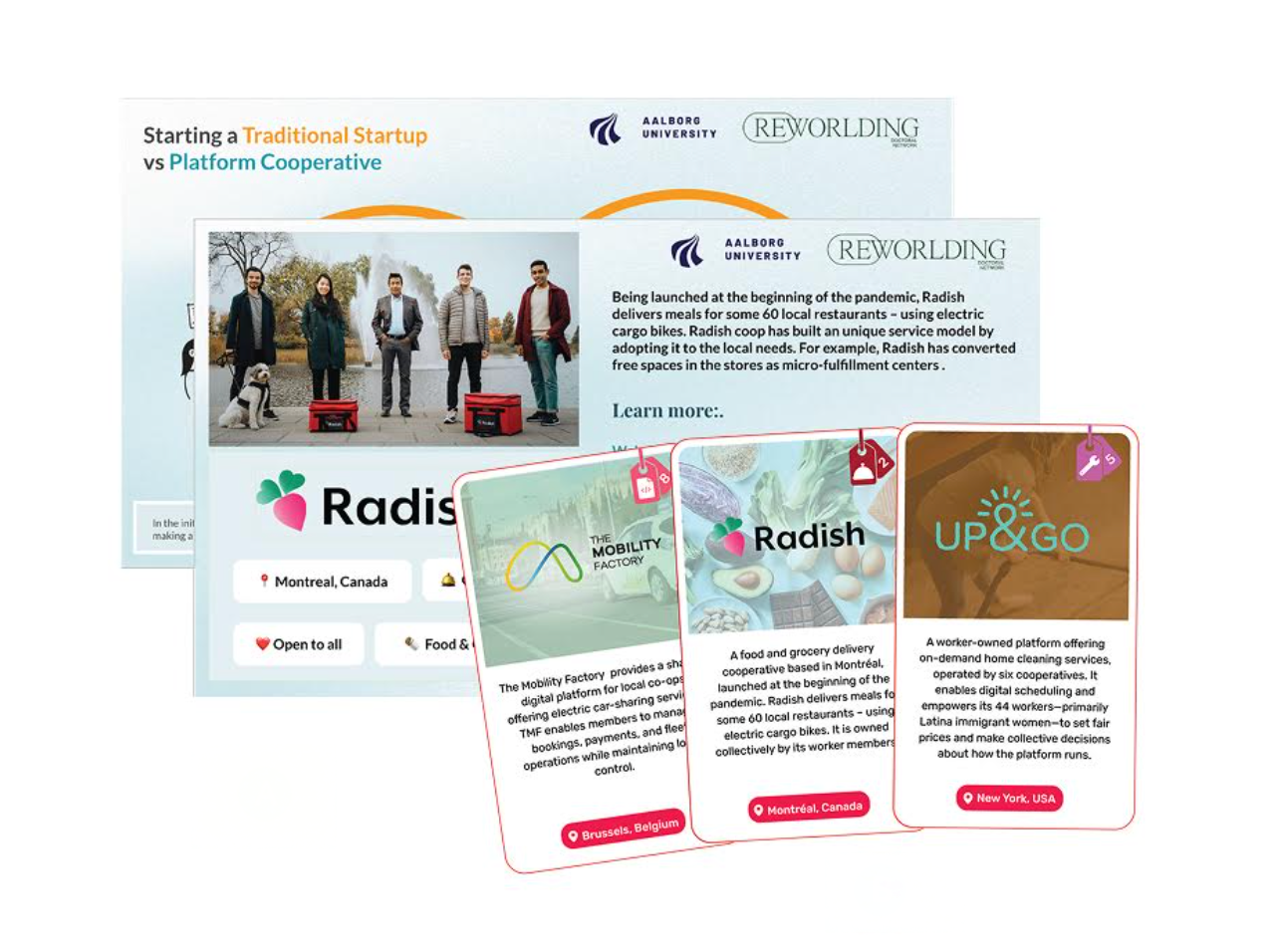
The Coop Deck
This is a set of 14 cards, each representing a real platform cooperative from around the world. Each card had a concise description and headquarters location along with a small icon denoting the service category, such as food delivery, digital goods, hospitality, etc. The information on these cards was crafted to spark curiosity at a glance by providing key details such as service offerings and scale of business.
When participants held the cards, something clicked. Someone could point to a card and say: “This is a delivery cooperative. It began with people like us.” Or: “Oh, this food cooperative reminds me of something we talked about in Coop Café.” The cards became conversation starters, not explanations.
The Platform Cooperative Guide
The guide included detailed descriptions of platform cooperatives along with related newspaper articles, research papers, podcasts, etc. As these artifacts serve as onboarding communication with a new participant, they are constantly getting updated with each interaction; for example, a FAQ section related to profit sharing was added based on the multiple discussions and interactions that took place within this group.
The Platform Cooperative Compass
A visual framework that helps groups reflect three interconnected dimensions:
Technology, Economy, and Governance. The Compass prompts simple questions that connect to the business model of the imagined cooperative. For example: “Who governs your platform? Is it homogeneous (e.g., workers only) or heterogeneous (e.g., multistakeholder)?” Or, “Who do you offer your product or service to (everyone, or only members of the cooperative)? The Compass asks five simple questions that could create a grounded and shared understanding of the platform cooperative the team is building.
Currently, the compass is being further developed to situate the framework in its context by including Danish policy references.
Forming Cooperatives Through Care
The first engagement with residents of Aalborg was kicked off by hosting an ideation workshop in May 2025. Co‑organized with the International House North Denmark, Aalborg Kommune, the workshop brought sixteen international residents together. Using the tools I mentioned earlier, participants formed groups and brainstormed four cooperative ideas: a cultural dining experience (a student project), a door-to-door cleaning service (pivot from a personally owned business), an integration and recruitment platform (pivot from a personally owned business), and a neuroinclusive tools marketplace.
But the workshop’s most important output appeared only after it formally ended. A group of participants stayed behind, talking excitedly in small clusters. They exchanged contacts, compared experiences of living in Aalborg, and asked how they could keep working together. This moment, quiet and organic, confirmed that people shared similar concerns. They then chose to keep meeting.
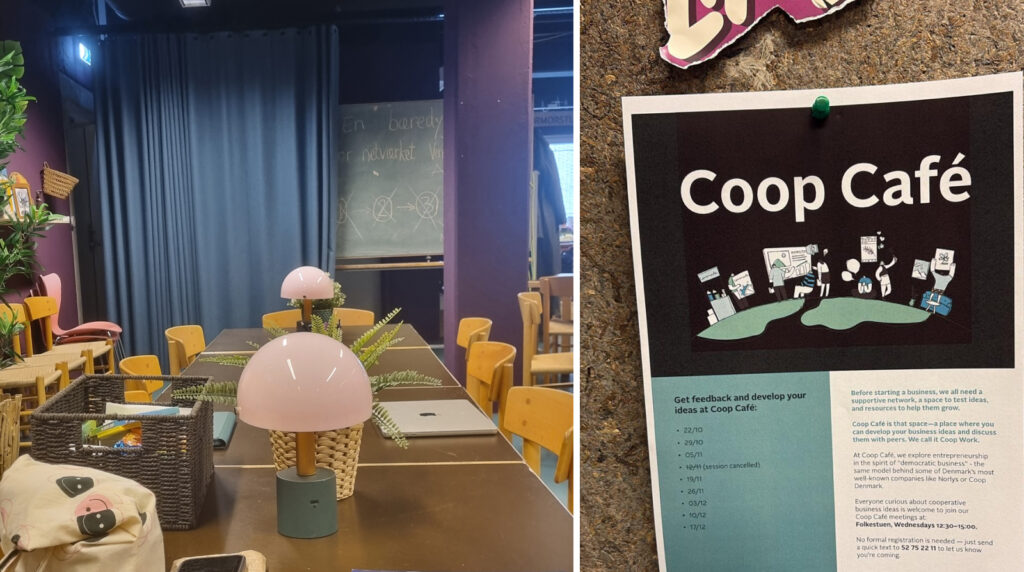
If the aforementioned tools made cooperative thinking accessible, Coop Café made it possible. Coop Café can be seen as a community-driven prototype of an experimentation lab for platform cooperatives.
One of the participants stepped forward, approached the Aalborg Main Library, and secured access to Folkestuen, a community room. This became Coop Café—a space chosen and claimed by the group itself. Coop Café blended work with warmth: people brought snacks from their home countries, checked in on each other, and discussed their cooperative ideas between conversations about their life struggles or job interviews. These practices, though simple, played a crucial role. Many participants were still insecure about the cooperative model and raised concerns about revenue sharing and decision‑making. The care practices inside Coop Café helped soften these fears.
Prototyping a Cooperative Future: KulturBox
The most tangible initiative to emerge from our work so far is KulturBox, a concept that began forming inside Coop Café. It emerged through a constellation of influences: the growing number of community‑driven food initiatives in Aalborg, the concept of the chef booking platform, and my own lived experience as an international resident navigating cultural integration through food.
As participants in Coop Café explored their cooperative ideas, food kept resurfacing as a medium of cultural expression and connection. The earlier concept of testing a chef‑booking platform provided the insight of what might be culturally accepted. Over time, that seed merged with broader conversations about community, sustainability, and food culture in Aalborg. With these threads, KulturBox began to take shape.
The concept is now defined:
KulturBox aims to build cultural and societal bridges through food, promoting vegetarian and plant-based meals inspired from across the world.
Before KulturBox becomes a full cooperative or a business, it is intentionally starting as a community initiative. This slower trajectory reflects both the group’s values and its realities. Food entrepreneurship carries real risks, especially for people already juggling job searches, caring responsibilities, and the emotional weight of uncertainty. Several participants have expressed feeling torn—drawn to the idea of KulturBox yet wary of the financial and regulatory demands of starting a food venture in Denmark.
To explore the concept safely, the team began service prototyping. The first prototype was a three‑recipe plant‑based meal kit, featuring dishes from two different countries represented within the team. Two test customers were selected, each receiving the meal kit along with instructions. Their feedback on taste, instruction clarity, portion size, and cultural framing helped refine the recipes and the communication around them.
As confidence grew, the team organized a public cooking event to understand how broader audiences might respond to cooking together, sharing food cultures, and the idea of a curated meal kit. The event attracted a diverse group of locals and internationals. Participants were enthusiastic, curious, and eager to engage. Even so, sustaining momentum is not easy. Between jobs, Danish classes, family responsibilities, and ongoing multihoming, team building and consistent commitment remain ongoing challenges. Everyone is doing the work they can, in the time they have, with the capacities they carry. At this delicate stage, institutional support—especially in navigating grants and early‑stage funding—is crucial.
That is why I have been working actively to connect the team with advisors from Kooperationen, We Do Democracy, and Business Aalborg, seeking clarity on cooperative pathways, food safety requirements, early-stage entrepreneurship, and, most importantly, available funding possibilities.
Designers Create the Conditions for Democratic Futures
Designers can build the conditions in which cooperatives can emerge, working first on the possibilities for shared meaning to surface. Through the lens of care, the designer’s work becomes infrastructural: maintaining relationships, noticing emotional dynamics, and ensuring participation feels safe enough for people to stay engaged. At the same time, the designer practices intermediation by mediating between grassroots aspirations and institutional systems so that emerging publics can negotiate resources and relationships.
Before cooperation exists, connection must exist.
And when connection becomes shared purpose, a cooperative can start to form.
Acknowledgement: The Reworlding project has received funding from the European Union’s Framework Programme for Research and Innovation—Horizon Europe, Marie Skłodowska-Curie Actions Doctoral Networks, under the grant agreement 101119451.